

The Two Sides of Jekyll & Hyde: Ja’ Malik and Richard Walters on Creating a New Ballet
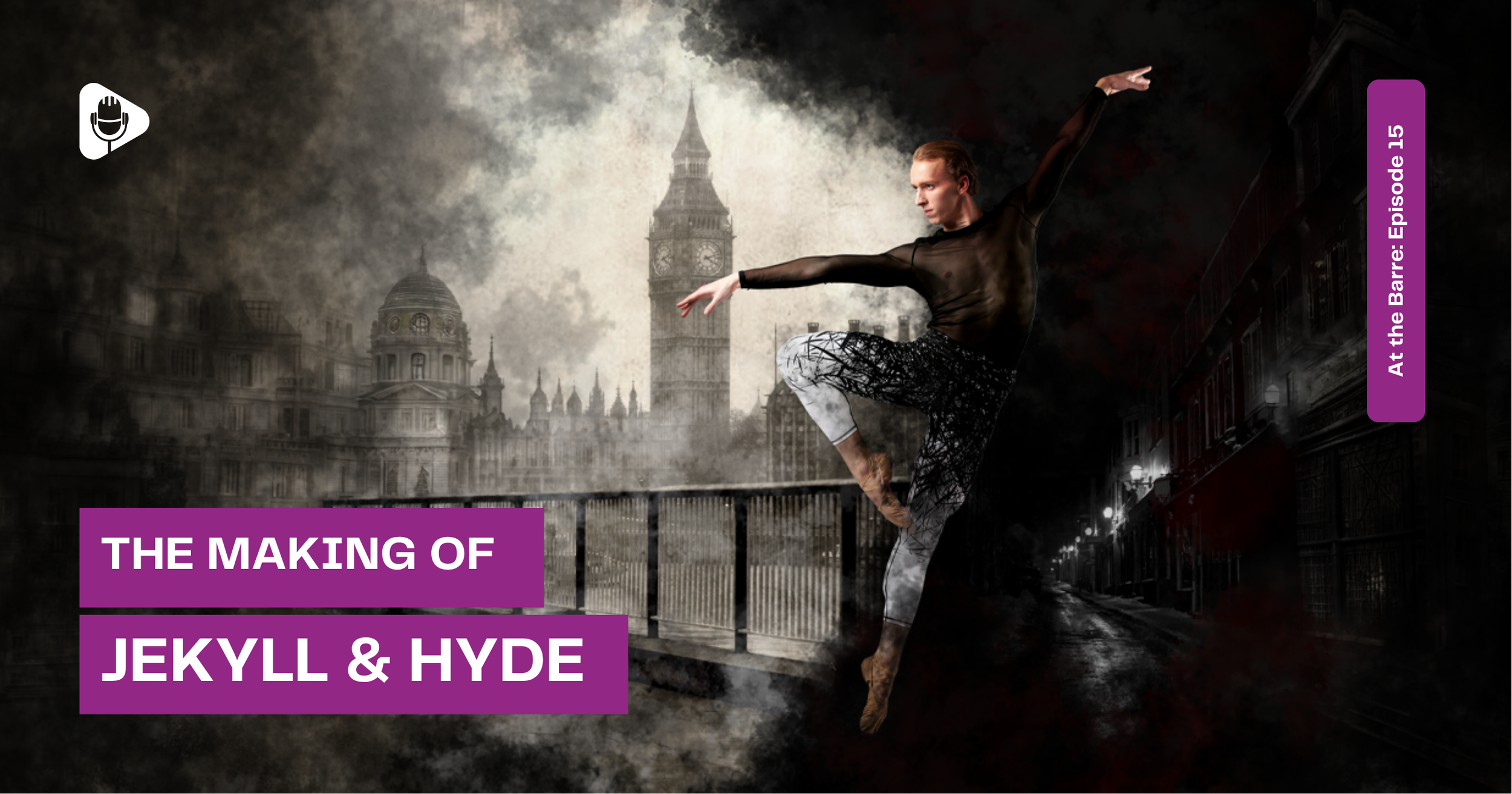
Written by Chris Fahrenthold and Caitlin Sloan
For Madison Ballet’s 45th anniversary season, two choreographers are bringing Robert Louis Stevenson’s classic story to the stage and discovering how its contradictions can open new possibilities for ballet.
There is something fitting about two choreographers collaborating on a ballet about the divided self. Each brings a distinct imagination, a different way of working, and a personal understanding of what movement can reveal. Yet the result must become a single work, with its own dramatic identity.
For Madison Ballet Artistic/Executive Director Ja’ Malik and Rehearsal Director/School Principal Richard Walters, that challenge is part of the attraction of creating Jekyll & Hyde, a new full-length ballet opening the company’s 45th anniversary season.
Inspired by Robert Louis Stevenson’s tale of a respectable doctor and his monstrous alter ego, the production is less concerned with conventional horror than with the contradictions of human experience: beauty and brutality, public identity and private struggle, discipline and abandon.
In a conversation with At the Barre with Madison Ballet host Chris Fahrenthold, Ja’ Malik and Walters discussed the musical origins of the production, the challenges of creating a ballet together, and what a nineteenth-century story might reveal about dance today.
Finding Jekyll & Hyde in the Music
For Ja’ Malik, Jekyll & Hyde began not with Stevenson’s novel, but with the music of Michael Nyman.
Nyman’s score for McQueen, the 2018 documentary about British fashion designer Alexander McQueen, had captivated Ja’ Malik since the film’s release. Its beauty and unease suggested a dramatic world in which opposing impulses might coexist within the same person.
“There’s this juxtaposition between two sides, the light, the beauty that is fashion, and then the darkness that can be the fashion world or just the world in general. So I think him tapping into that side of his fashion through his music made me think immediately, Jekyll & Hyde, that’s perfect. Dual personality, two different points of view from one person.”
With Madison Ballet’s season opening around Halloween, Ja’ Malik had considered other stories with darker associations, including Frankenstein. But Jekyll & Hyde offered a psychological conflict that could be expressed through the body.
Walters was immediately attracted to the opportunity to make something new and test what a familiar narrative might become in the language of dance.
“I felt like with the story of Jekyll & Hyde, we can stretch it out, push the envelope of ballet and theater and story and characters. And that’s always exciting to me.”
Nyman’s score helped make the choice irresistible. As Walters observed, “sometimes you hear music, and you’re just like, that’s it.”
The music became more than an accompaniment to a predetermined story. It was the imaginative starting point, suggesting both the emotional atmosphere and the opposing forces that would animate the ballet.
The Beauty and the Darkness
Although audiences may associate Jekyll & Hyde with Halloween, Ja’ Malik is not particularly interested in creating a conventional horror ballet. Instead, the production explores what the story’s central division reveals about ordinary human experience.
Stevenson’s premise is unsettling because Jekyll and Hyde are not simply two unrelated characters, one good and one evil. They are aspects of the same person.
For Ja’ Malik, this tension has contemporary resonance. Public figures are celebrated for their achievements while the complications of their private lives remain invisible. Celebrity culture encourages us to construct idealized versions of people, only to turn against them when those ideals prove impossible to sustain.
Ballet, too, has its public face and its hidden realities.
Audiences encounter grace, control, apparent effortlessness, and extraordinary beauty. Behind that appearance are hours of repetition, physical strain, frustration, and uncertainty.
“There’s the duality there that we present this beauty on stage, but the process to get there is quite grueling, even for us as choreographers.”
In that sense, Jekyll & Hyde is not simply a story being translated into ballet. Its subject already belongs to the art form. Ballet makes visible something beautiful through a process that is often anything but effortless.
What Happens When Classical Ballet Meets Hyde?
The division between Jekyll and Hyde presents a compelling choreographic question: Can their opposing identities be expressed through different kinds of movement?
Both choreographers are interested in stretching ballet’s established vocabulary without losing the qualities that make it recognizable.
For Ja’ Malik, classical technique remains essential, but its expressive possibilities are far from exhausted.
“I do think that there’s a place to see your classical beauty and there’s a place to see that classical beauty transformed to an audience today.”
Walters approaches the question through the physical language of the characters themselves. Jekyll’s outward respectability and Hyde’s less restrained nature suggest different relationships to the classical body.
“You can think of Jekyll as maybe the classicism and Hyde as this contemporary modern if you wanted to. And I’m kind of exploring that in the movement.”
The distinction need not be absolute. The familiar shapes of ballet can be distorted, extended, or transformed, just as Jekyll’s familiar identity gives way to something less predictable.
For Walters, this exploration raises questions about the future of ballet itself.
“How do I keep stretching it and pushing it, because it’s trying to still be able to show that this is ballet, this is pointe shoes, and this is how we stand, this is how we move, but it’s evolved, right? What’s the next level?”
There is another departure from convention in the choice of story. Many of ballet’s best-known full-length narratives center on female protagonists. Jekyll & Hyde places a male character, and the conflict within him, at the dramatic center, offering another opportunity to reconsider whose experiences ballet brings to the stage.
Two Choreographers, One Ballet
If the story explores opposing impulses within a single person, its creation involves a different kind of negotiation: two independent artists working toward a shared vision.
Ja’ Malik and Walters describe their choreographic processes as distinct but complementary. One may find a solution quickly while the other continues to experiment. An idea that initially seems promising may prove inadequate once dancers begin working with it.
For Walters, such reversals are fundamental to the creative process.
“To me, I feel like in my process, there’s always the birth, the death, and then the rebirth of it. There’s always a point I get to where I’m like, I gotta scrap everything I’m doing.”
Collaboration can make those moments less isolating. When one choreographer reaches an impasse, the other may recognize a possibility that has gone unnoticed. A suggestion or different perspective can return an idea to motion.
Nor is their collaboration simply a matter of assigning scenes to separate creators and assembling the results. Music, characters, movement, and dramatic structure continue to influence one another as the ballet takes shape.
What emerges is not merely a compromise between two visions, but a work neither choreographer could have arrived at in quite the same way alone.
Creating a World Without Explaining Everything
The choreography is only one part of the world Ja’ Malik and Walters are building.
Costumes, lighting, and projections will help establish the atmosphere of Jekyll & Hyde, but the production is not intended as a literal reconstruction of Victorian London. Its setting is recognizable without being tied to a precisely defined historical moment.
Rather than prescribe every visual detail, Ja’ Malik has encouraged the designers to follow their imaginations.
“The main thing I say at the end of every email or every call is: I trust you, get creative and go crazy. Like, take me there. Let’s see where we can go. Cause I have no answers. That’s the beauty of the creation of this whole thing. I have no answers. It’s all exploration for me. It’s all play. It’s all figuring it out.”
It is a revealing description of artistic leadership: the willingness to invite other artists into the process without already knowing exactly what the result should look like.
The theatrical elements will give the ballet a distinctive visual world, but Ja’ Malik is equally interested in what remains unresolved. A projection may suggest rather than explain; a costume may establish a character without defining every aspect of that character’s identity.
The aim is not to overwhelm the choreography with spectacle, but to create an environment in which movement, music, and design contribute to the audience’s experience without dictating a single interpretation.
The Freedom to Watch
For all the conceptual questions raised by Jekyll & Hyde, neither choreographer wants audiences to feel they must solve an intellectual puzzle to appreciate the performance.
Ja’ Malik returns to one of the qualities that first attracted him to dance: its capacity to communicate without the demands of spoken language.
“What I loved about ballet and still love about ballet and dance in general is that we’re speaking without words. That’s what I love. Because I feel like words can get in the way.”
Dance can suggest relationships, conflicts, desires, and emotions without naming them. It can make an experience recognizable while leaving its meaning open to interpretation.
That openness remains a source of discovery for Ja’ Malik himself. Even after decades in the profession, he still encounters something unexpected in class or rehearsal that reminds him how much remains possible.
Walters similarly encourages audiences to trust their own responses. Two people may attend the same performance and come away with entirely different impressions. Even seeing the same work a second time can reveal something new.
The value lies partly in the freedom to notice, to feel, and to wonder.
That may be the most inviting way to approach Jekyll & Hyde. Audiences will encounter a familiar story, but not necessarily a familiar interpretation. They will see classical ballet alongside movement that challenges its conventions, and theatrical images that suggest more than they explain.
The contradictions are not problems the production must resolve. They are what make the story worth telling, and what give its choreographers room to discover something new.
For Madison Ballet’s 45th anniversary season, Jekyll & Hyde offers a reminder that an art form rooted in centuries of tradition can remain a place of genuine experimentation. Its beauty need not exclude darkness, its discipline need not prevent freedom, and its familiar language can still say things we have not heard before.
Jekyll & Hyde opens Madison Ballet’s 45th anniversary season at the MYArts Center in Madison, Wisconsin, with a public preview on Thursday, October 29, 2026, and performances continuing through Sunday, November 1. Tickets and performance information are available at https://www.madisonballet.org/jekyll-hyde-info.