

Madison Ballet’s Next Chapter: Bringing Ballet Into the Community
Written by Chris Fahrenthold and Caitlin Sloan
As Madison Ballet begins its 45th season, Madison Ballet Outreach is bringing the company’s dancers, artists, and creative process beyond the theater and into the community.
For the past year, Madison Ballet Special Projects has been experimenting with what it means to make ballet more accessible—not simply by putting dancers onstage, but by inviting the community into the ideas, people, and processes behind the art form. Now, that work is entering a new chapter.
As Madison Ballet begins its 45th season, Special Projects has evolved into Madison Ballet Outreach, a division of the company itself. The transition brings a new level of integration and resources to work that has already included library storytimes, school demonstrations, social media, podcasts, and community events.
At the center of that effort are Director of Outreach Chris Fahrenthold and Outreach Programs Coordinator Caitlin Sloan, who have spent the past year building programs from the ground up. Their goal remains straightforward: bring more people to ballet while helping them understand and feel connected to the art form happening in their own community. “I'm actually very confident in ballet's future,” Fahrenthold says. “It is a beautiful discipline, and it's an art form that justifies itself just by doing it.” But, he adds, ballet still needs to explain itself. “I said ballet justifies itself because I think the doing of it is worth doing, but it doesn't explain itself. And that is where I think we come in.”
From Special Projects to Madison Ballet Outreach
The transition from Special Projects to Outreach is less about starting over than building on what already worked.The biggest change is that Outreach is now more deeply embedded within the company. “We will a lso still be visible at Madison Ballet performances and at events around libraries and schools and bookstores and spaces around town,” Fahrenthold says. “And we will also still be producing content that shares the beauty and intricacy of ballet through social media and this podcast.”
But being part of the company itself creates opportunities to expand. “We'll be able to serve even more libraries and schools with our story times and demonstrations because we'll take on more dates,” he says. “When it was just, you know, you and I, there was a finite amount of time and space that we could occupy.”
Now, Outreach can draw on the broader Madison Ballet community, including School of Madison Ballet faculty, company dancers and trainees. “We'll also be able to be more intentional and coordinated with our programming,” Fahrenthold says. “So we'll get to pick and choose what we are good at and strategically invest in that.”
For Sloan, that integration is particularly exciting. “I know we're both so passionate about this company, and I'm just feeling really honored to be officially on the team in this capacity and be able to work with all the staff more closely.”
Building the Next Generation
One of the biggest developments for Madison Ballet this season is the expansion of its trainee program, with seven dancers from around the country joining the company. For Sloan, who has spent much of her career helping dancers navigate the transition into professional life, the program is a natural fit with Outreach. “I'm really excited about the expansion of our trainee program this year,” she says.
Trainees occupy a unique space between student and professional dancer. Unlike upper-level School of Madison Ballet students, who attend classes after school, trainees are at the studio from 9:30 a.m. to 5 p.m., combining dedicated training with company rehearsals and performances. “It's sort of the stepping stone into a professional company,” Sloan says. “You're kind of in between student and professional dancer. You're bridging that gap.”
Their days include ballet, pointe, variations, and other classes specifically designed for them, but they also rehearse alongside the professional company. “So you're getting a little taste of both worlds,” Sloan says. “There's definitely things technically that we want to keep really honing and working on. And having those individual classes gives me as a teacher more time to work on those things and really dive deeper into the technique. But then you're also learning what it's like to be within a company setting and what a rehearsal process is like and kind of what your role is.” That dual experience also makes the trainees an important part of Outreach programming. “They're getting to perform in the community through our outreach programs,” Sloan says. That has already included a visit to EAGLE School, where the dancers demonstrated what it is like to be a professional ballet dancer through class, performance, and conversation with students.
Remembering Why You Dance
Sloan is also choreographing on the trainees this season, and the experience prompted her to think about what she wanted to give dancers at the very beginning of their professional careers. “When I interview dancers who are maybe retired or at the end of their career, what so many of them say they wish they would have known or understood earlier was that you have to have fun and that it's going to fly so fast and you should enjoy all these moments.” That idea became the foundation of her new choreography.
Sloan chose to make the work lighthearted and fun while still challenging the dancers technically. “They're working really, really hard, but it's fun, and they get to enjoy themselves and show their personality,” she says. “So I wanted to have that opportunity for them to feel like they could just come out and dance and have a good time and remember, even when it gets stressful, that it's ballet, it's fun, it's supposed to be enjoyable, and that's what we're doing it for.” The reminder is particularly meaningful because Sloan knows firsthand how quickly a professional dance career passes. “I feel that way as a retired dancer; it goes by so, so fast, so you have to enjoy it.”
For Fahrenthold, that piece also demonstrates the broader purpose of Outreach: showing audiences that ballet is not limited to the familiar story ballets they may already know. “They might think ballet is Swan Lake, Sleeping Beauty, The Nutcracker, but no, you, you use the movements and technique in a really fun way whenever that piece is performed,” he says.
Meeting People Where They Are
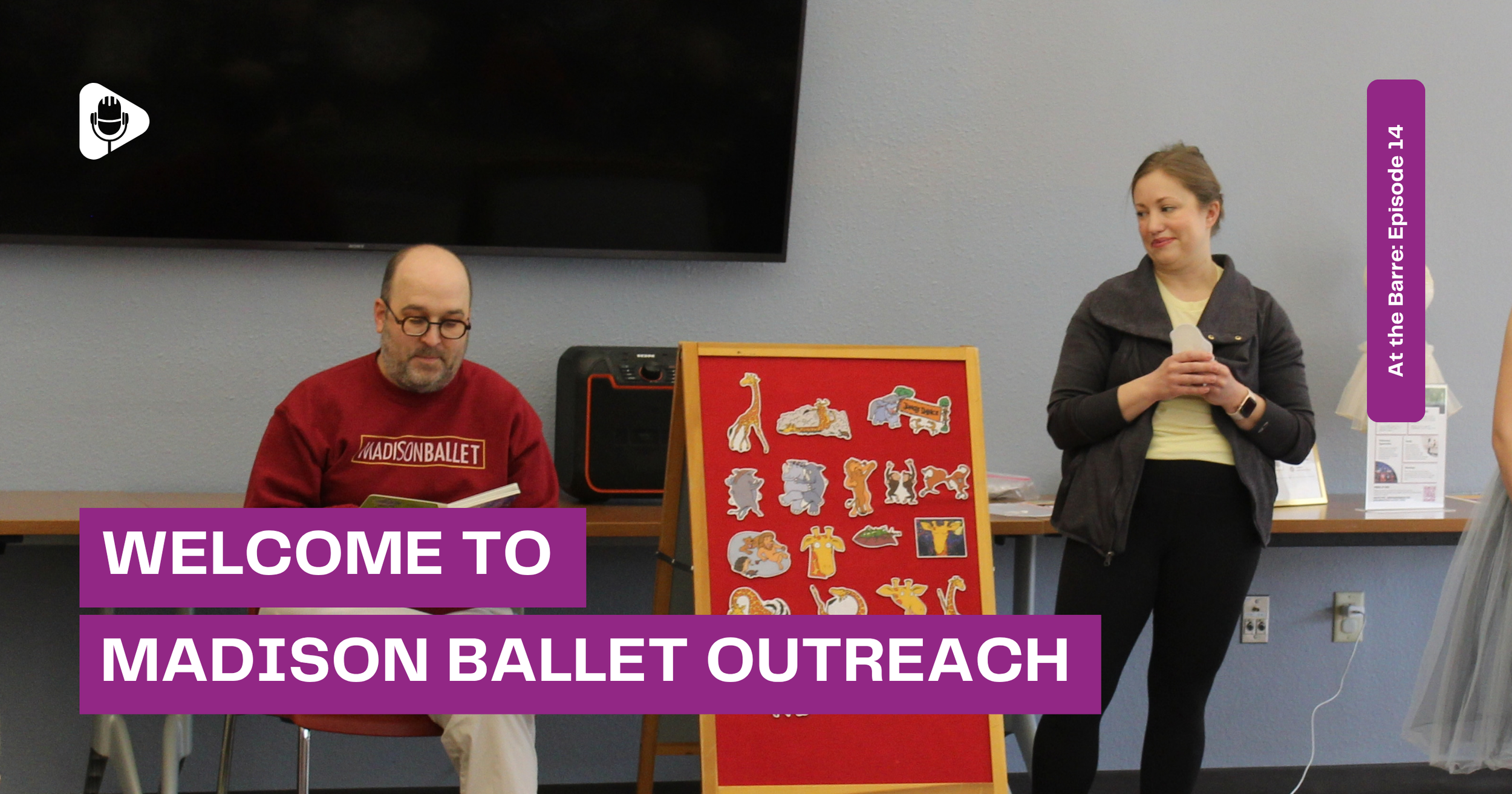
That philosophy is particularly evident in Madison Ballet's Nutcracker Storytime program. This season, the company will visit 11 libraries in the Madison area, bringing a shortened version of the story and an introduction to ballet directly into the community. “I just love the opportunity to bring a program to where people already are,” Sloan says. “Because I know when you have small kids, trying to bring them to The Nutcracker may not always work.”
The goal isn't to replace the experience of seeing a full-length ballet. It's to create another pathway into it. “At the very least, we're getting to see kiddos in the libraries and getting to share the beauty of ballet and the magic of the story with them right where they already are.”
That idea extends beyond young children. Outreach hopes to work with schools, libraries, bookstores, and other community organizations throughout the season. “We're super excited to come out and bring ballet to your group or your school in the community,” Sloan says. “So if you have an event coming up, reach out to us and just let us know what's going on.”
Looking Beyond the Dancers
Another evolution for the Outreach program is broadening the stories it tells. The At the Barre Podcast will continue interviewing dancers and choreographers, but Fahrenthold wants to explore the many people whose work makes a ballet production possible. “We'll still be interviewing choreographers and dancers, but part of what I'm excited for now is to expand to other artists and artisans who go into making ballet.”
That includes costume designers, lighting designers and stage managers, as well as coaches and other specialists who work behind the scenes. “It's a big production, and I don't think the public often gets to hear from or about, say, the costume designer or the lighting designer.”
The same philosophy will extend into the theater itself through opening-night Q&As, pre-show talks, and displays of production artifacts. Fahrenthold is particularly interested in giving audiences a closer look at the physical details of ballet, including costume sketches, fabric swatches, and other objects that help reveal the process behind what audiences see onstage. “That sort of multi-sensory experience of ballet, from the loud clacking of pointe shoes on the Marley to the sparkle of a light on a particular crystal embroidered onto a tutu, is something that once you experience it, you'll want to keep experiencing it.”
And that, ultimately, is the point. “As you know, that's kind of our goal here — getting people to keep coming to the ballet.”
Building Something That Lasts
For Sloan and Fahrenthold, the move into Madison Ballet Outreach represents more than a change in title or organizational structure. It creates the possibility of building programs that can continue long after the two of them are no longer the people running them. “This will become more of a legacy because like you said, it's the 45th season of the company,” Sloan says. “And before it was just you and me going out into the community, just very grassroots.” Now, those ideas can become part of the larger institution.