

Janessa Urwin on the Art of Costume Design for Jekyll & Hyde
Written by Chris Fahrenthold and Caitlin Sloan
From the studio to the costume shop, professional dancer turned costume designer Janessa Urwin brings a performer’s perspective to Madison Ballet’s upcoming production of Jekyll & Hyde.
A ballet costume has to do more than bring a character to life. It must move with the dancer, withstand the demands of performance, and, in some cases, provide the structure needed to make a lift possible. For costume designer Janessa Urwin, understanding those demands begins with experience on the other side of the curtain.
Urwin, who designs costumes for American Repertory Ballet and is the costume designer for Madison Ballet’s upcoming production of Jekyll & Hyde, didn't originally set out to build a career in costume design. She began as a ballet dancer, studying at the Nutmeg Conservatory for the Arts before going on to professional contracts. An opportunity in the costume shop at American Repertory Ballet eventually opened the door to a new creative path.
Now, her work combines research, construction, and collaboration to create costumes that support both the visual world of a production and the physical realities of ballet. For Jekyll & Hyde, that means translating a story of psychological transformation and dual personalities into a contemporary aesthetic informed by Victorian history, medical imagery, and the contrast between light and dark.
Designing for the dancer's body
Urwin's experience as a professional dancer continues to inform nearly every aspect of her design process. She understands that a costume may look beautiful on a sketch or mannequin but fail entirely if it prevents a dancer from executing the choreography.
“If the costume doesn't allow the dancer to do what they need to do, there's no point in wearing the costume,” she says. “You might as well just put on a leotard and tights and go do it.”
That practical understanding shapes her work from the beginning. Rather than thinking about movement only after a costume has been designed, she considers how each garment will function as she develops it.
During fittings, she'll ask dancers to test the costumes by moving in ways that might seem unusual outside the studio. The goal is to discover potential problems before they happen onstage.
“A lot of times when I have dancers in my fittings too, I'm making them do really silly things to make sure that the costume is going to do what it needs to do,” she explains. “And sometimes a dancer will say, oh, no, I feel like I'm going to rip it. And I say. Just do it. Rip it. Because if it rips in this seam, then I know that that seam is too tight and either it needs a stretch gusset in there, or it needs to be looser or something.”
Flexibility, however, isn't always the answer. A costume must be designed for the specific demands of the choreography, including partnering.
Urwin points out that a structured bodice can be safer for a dancer being lifted than a garment made from slippery or excessively stretchy fabric. The structure gives a partner something secure to hold, reducing the risk of hands slipping during a lift.
For Urwin, functionality isn't separate from the artistic vision. It's part of what makes the vision possible. She wants dancers to feel safe, comfortable, and confident in what they're wearing. When those needs are met, the costume can do its job: helping the dancer inhabit a character and tell the story.
Building the world of Jekyll & Hyde
Urwin's collaboration with Madison Ballet began through choreographer Ja’ Malik, with whom she had previously worked at American Repertory Ballet.
When Malik first contacted her, he shared a mood board of images, colors, and concepts. It gave Urwin a starting point for understanding the production's overall direction while leaving room for her own research and interpretation.
Although the original story takes place in Victorian London, Ja’ Malik wanted a more contemporary setting. Urwin began exploring how the production could acknowledge its historical roots while feeling connected to the present.
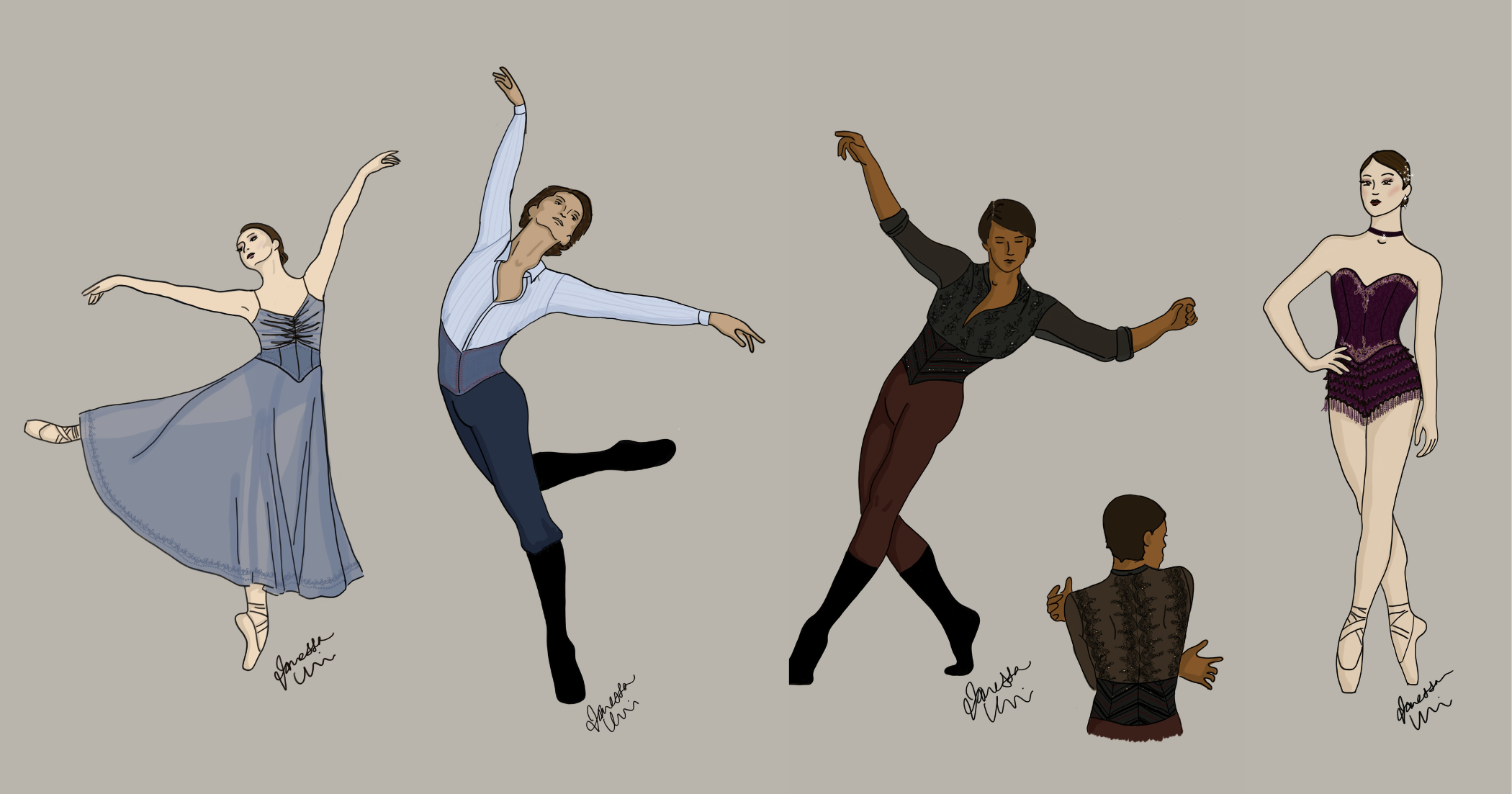
“I kind of took a medical approach. I did a lot of research on medical X-ray imaging and scans and brain neurons and synapses,” she explains.
Those references helped her develop a visual language for the story's central psychological conflict. Web-like fabrics and lace suggest the inner workings of the brain, while contrasting colors and textures distinguish the different sides of the production's characters.
“We wanted the Jekyll version to be a bit lighter. It's all very grayscale, a little bit of blue for Jekyll.”
Hyde's world, by contrast, is darker and more mysterious, with sheer fabrics, lace details, and touches of sparkle. Burgundy and purple introduce a sense of nightlife and underground entertainment.
The character of Emma, Jekyll's female counterpart, wears gray-blue tones and a flowing silhouette, with a darker lace overdress and a structured corset belt. That structure serves a practical purpose, too: Urwin anticipated that Emma would need to be partnered frequently.
For Lucy, she turned to historical circus and cabaret costumes. The resulting purple look was intended to evoke a recognizable character without tying her to a specific historical period.
“I wanted her costume to feel timeless,” Urwin says, describing the balance between vintage inspiration and a more contemporary sensibility.
The designs emerged through an iterative process. Urwin created mood boards for individual characters, shared them with Ja’ Malik and co-choreographer Richard Walters, and used their feedback to develop her sketches.
That balance between direction and creative freedom is central to her work. Some choreographers arrive with specific images and ideas; others look to the designer to help establish the visual world of a piece. In either case, Urwin's task is to ensure the costumes reflect the music, movement, and emotional atmosphere of the production.
The work doesn't end at opening night
Designing a costume is only one part of bringing it to the stage. Once dancers move into the theater, the costumes must be tested under performance conditions, and the wardrobe team must ensure everything functions smoothly.
Urwin works closely with wardrobe supervisors, who oversee dressing, laundry, organization, and repairs. During technical rehearsals, she watches how the costumes look under the lighting and how they function during transitions.
Changes may be necessary once the costumes encounter the realities of the theater. A detail that seemed effective in the studio might disappear under the lights, or a quick change might require a different approach.
For Urwin, that continuing collaboration is essential.
“I really want to make sure that everything is working well,” she says. She sees her responsibility as extending beyond delivering finished garments; she wants to help the wardrobe team solve problems and ensure the production can run successfully.
Opening night, however, marks a shift in ownership.
“Once we get to opening night is kind of when I consider, now it's not mine anymore. Now it belongs to the dancers, the choreographers, and ultimately the audience. It’s for them now.”
It's a fitting perspective for work that exists in service of a larger artistic whole. The costumes are carefully researched and constructed, but their ultimate purpose is realized only when dancers wear them, and audiences experience the production.
Finding a place in the arts beyond performing
Urwin's own career illustrates how many different roles exist within the dance world. She has worked in costume design, construction, wardrobe management, and dressing, each requiring a different combination of skills.
She encourages dancers who are uncertain about pursuing a professional performance career (or who are considering what comes next) to look beyond the stage without feeling that doing so means abandoning dance.
“The world is a lot bigger than ballet,” she says.
For dancers who want to remain in the arts, she suggests exploring the people and departments that make performances possible. Scenic design, lighting, stage management, production management, fundraising, and development are among the many areas where dancers might discover an interest or find that their existing skills transfer.
Her advice is straightforward: talk to the people already doing the work. Ask what they enjoy, what challenges they face, and what training or experience might be necessary to pursue a similar role.
For Urwin, the goal is to remain open to opportunities and to recognize that a life in the arts can take many forms.
As she continues designing for ballet and exploring opportunities in opera, theater, and television, she brings the perspective of someone who understands both the demands of performing and the work that happens behind the scenes.
And in Jekyll & Hyde, that perspective will be visible in every costume: not only in the characters they help create, but in the thoughtful construction that allows the dancers to bring those characters to life.
Jekyll & Hyde opens Madison Ballet’s 45th anniversary season at the MYArts Center in Madison, Wisconsin, with a public preview on Thursday, October 29, 2026, and performances continuing through Sunday, November 1. Tickets and performance information are available at https://www.madisonballet.org/jekyll-hyde-info.