

Getting into Character: Ben Shepard and Alex Vrba on Becoming Jekyll & Hyde
Written by Chris Fahrenthold and Caitlin Sloan
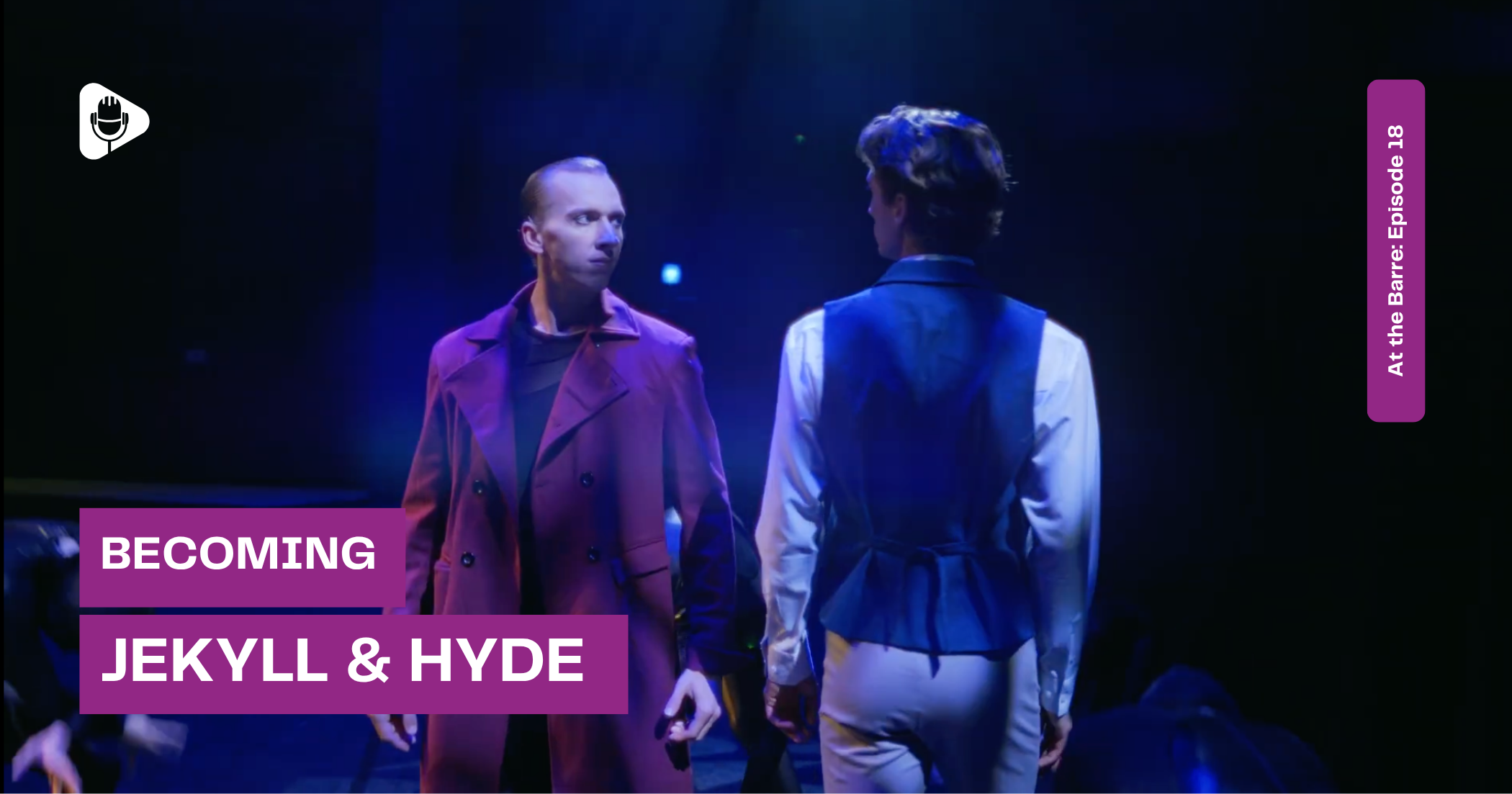
Madison Ballet company dancers Ben Shepard and Alex Vrba take on the roles of Dr. Jekyll and Mr. Hyde in Madison Ballet’s upcoming world premiere of Jekyll & Hyde.
When Madison Ballet company dancers Ben Shepard and Alex Vrba take the stage in Jekyll & Hyde, they’ll be doing more than bringing two familiar characters to life. Through movement, they’re exploring the tension between ambition and ego and the darker impulses that can exist alongside our best intentions.
Shepard dances Dr. Jekyll, a scientist whose dedication to his work begins to overtake his life. Vrba plays Mr. Hyde, the physical embodiment of Jekyll’s darker side. Working with choreographers Ja’ Malik and Richard Walters, the dancers are discovering their characters rehearsal by rehearsal, finding ways to communicate the story through classical technique, contemporary movement, and theatrical details.
Developing the characters through movement
For both dancers, developing their roles in Jekyll & Hyde has meant looking beyond a straightforward interpretation of the familiar story. Rather than simply recreating the plot, the production explores broader ideas about human nature through the characters.
Shepard approached Dr. Jekyll by reading the original book and considering the character’s motivations. He describes Jekyll as a scientist deeply invested in his work, whose ambition and ego complicate his personal life and ultimately influence his decisions (with ultimately catastrophic results).
One contemporary parallel that occurred to Shepard was the development of technology. Like Jekyll’s experiments, technological innovations can begin with good intentions while producing unintended consequences.
For Vrba, the starting point was somewhat different. A fan of the musical, he drew inspiration from previous interpretations of Hyde while continuing to discover how to portray the character physically.
The distinction between the two roles becomes especially clear in their movement qualities. Shepard describes Jekyll as being represented through the more classical side of ballet, with the character’s discipline and mastery reflecting his dedication to his work.
“Jekyll's being represented through the more technical side of ballet,” Shepard says. “The freedom to express oneself in ballet is only found through devotion to technique.”
Hyde, meanwhile, is allowed to move in ways that depart from the classical lines and precision expected of a ballet dancer. Vrba has enjoyed exploring a more sinister physicality, drawing on the experience of performing in Dracula with MainStage Academy of Dance shortly before the premiere of this production.
“In ballet we're always a toe-heel whenever we walk,” he says. “But I have been blessed with the ability to go heel-toe.”
For Vrba, the physicality helps communicate Hyde’s role as an embodiment of Jekyll’s temptations and darker impulses.
“The way I envision Hyde in this ballet is like I am the personification of Jekyll's temptations, his lust, the side of him that wants to explore these darker sides of himself.”
The two dancers also influence one another’s interpretations. As they explore their characters together, Vrba finds ways to take Jekyll’s movement and distort it into something more sinister.
“Ben definitely brings a lot to the table that I can bounce off of him,” Vrba says. “Ben has really helped me develop Hyde and, like, almost twist what Jekyll, or twist what Ben is doing. I can twist those movements and make them my own, in a more sinister fashion.”
The freedom of becoming someone else
Although character-driven roles can require dancers to inhabit specific personalities and emotional journeys, both Shepard and Vrba find that embodying a character actually frees them up physically.
For Vrba, having a character to focus on can take some of the pressure off executing every step perfectly.
“I would say to have a character to go off of is very freeing,” he says. “If you overthink something, then you're so focused on it you can't think about anything else.”
Instead, he can focus on the music, the character, and what he wants to communicate to the audience.
“Having a character really opens my mind personally to just feel the movement and focus on the music and what I'm portraying or how I'm acting things out,” Vrba says. “The character really helps free up the body.”
Shepard also enjoys the separation between himself and the person he portrays. Rather than thinking about what he, Ben Shepard, would do in a particular situation, he considers what Jekyll would do.
“It's fulfilling to be able to just represent something entirely different,” he says. “It's almost as though, like, oh, Ben Shepard is not concerned about this performance because Jekyll will be performing.”
That distinction can make mistakes feel less personal, too.
“If Jekyll messes up, Jekyll messes up. But Ben's still Ben.”
What audiences can expect from Jekyll & Hyde
For someone who has never attended a ballet, Shepard hopes the production will offer the excitement and escapism of a story brought to life through multiple art forms.
“It's going to be a spectacle,” he says. “That's the magic of what story ballets are, that it's a form of escapism for the audience, ideally.”
He sees the production as a meeting point for the ideas of the choreographers, costume designers, lighting designers, and dancers. The result is something that can be experienced differently by every audience member, and even differently from one performance to the next.
“It's a representation of human nature,” Shepard says. “It's really fascinating, and I think it's always a great gift to see aspects of the human imagination on display.”
Vrba agrees, emphasizing not only the artistic collaboration behind the ballet but also the physical demands of the performance.
“There's a lot of things that people outside of dance don't experience, like people getting lifted over their heads and stuff like that,” he says. “So that's always exciting to watch.”
He hopes that both newcomers and longtime ballet audiences will find something personal in the experience.
“I think that a lot of newcomers will find that the show is for them personally,” Vrba says. “Like, oh, this was made for me, because no one's going to see it like I did tonight.”
The importance of making mistakes
When asked what advice they would give to younger dancers, both Shepard and Vrba returned to the importance of embracing mistakes rather than being afraid of them.
For Vrba, who began ballet later than many of his peers, the fear of looking foolish was something he had to work through.
“Don't be afraid to look stupid,” he says. “As dancers, especially like when I was 15, I was just afraid of just looking like a fool in class and, you know, messing up, not getting it right the first time.”
His perspective has changed with experience. Progress doesn’t require perfection, and dancers shouldn’t be afraid to accept help along the way.
“Everyone is on their own journey, and any progress is good progress,” Vrba says. “So don't be afraid to look foolish. Everyone is there to help you.”
Shepard echoes that advice, adding that dancers should actively seek criticism and learn from what goes wrong.
“Do not be afraid to stand out. Do not be afraid to, you know, look a fool, but also accept the criticisms. Seek the criticism,” he says.
For him, the important thing is to learn from mistakes rather than repeat them without reflection. He encourages his students to consider the root of a problem and give themselves time to work through it.
“There's no bad turning days. There's no bad days. There are just days that take a little bit longer to adjust to,” he says, recalling advice from one of his early teachers.
Instead of dismissing a difficult day as a failure, dancers can use it as an opportunity to learn.
“Accept that there's still something to be learned from it,” Shepard says. “And, you know, at the end of the day, that's progress. And the progress is made on the “worst days”, not on the days you feel your best.”
It's a lesson that extends well beyond the ballet studio. For two dancers preparing to embody characters whose stories explore the consequences of ambition, ego, and human imperfection, embracing the messy process of learning may be just as important as mastering the steps.
Jekyll & Hyde opens Madison Ballet’s 45th anniversary season at the MYArts Center in Madison, Wisconsin, with a public preview on Thursday, October 29, 2026, and performances continuing through Sunday, November 1. Tickets and performance information are available at https://www.madisonballet.org/jekyll-hyde-info.