

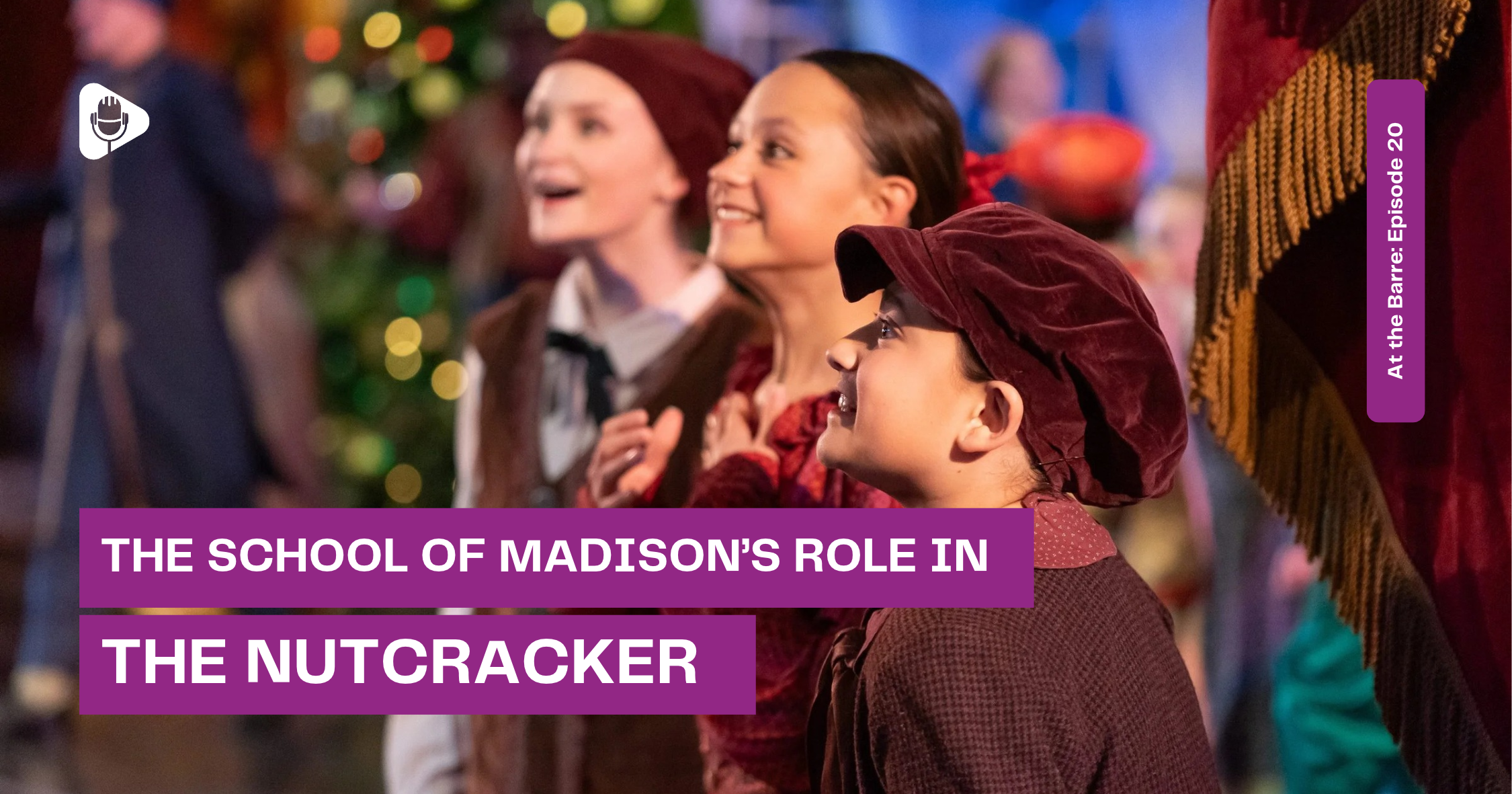
Written by Chris Fahrenthold and Caitlin Sloan; Photo by Ellen Crane
Every fall, as Madison Ballet begins preparing for its annual production of The Nutcracker, the company and school enter one of their busiest (and most collaborative) times of the year.
For Richard Walters, who serves as both Rehearsal Director for Madison Ballet and Principal of the School of Madison Ballet, the production offers a unique opportunity to bring together two parts of the organization that work toward a shared goal throughout the year.
“It's a very meaningful connection between the school and the professional company,” Walters says. “I think it's something that really binds the organizations together as one. It's really the one moment in the year that we can get everybody together.”
And while audiences may come to see the familiar story, Tchaikovsky's music, and the artistry of the professional dancers, the students of the School of Madison Ballet play an important role in making the production what it is.
For the students, that means much more than learning choreography and performing on a professional stage. It is a chance to see their training come to life and work alongside the professional dancers they may one day hope to join.
A Connection Between the Classroom and the Stage
One of the most meaningful aspects of The Nutcracker is the way it makes the progression of a dancer's training visible.
Students begin their journey in the school's earliest levels, building their technique and developing as artists. As they advance, they take on new challenges and more involved roles in the production. For families and members of the community, The Nutcracker offers a chance to see that journey unfold.
The performance experience itself is essential to a dancer's development. Students spend countless hours in the studio working on technique, consistency, and musicality, but the stage introduces an entirely different set of skills.
“It's a performance opportunity which is crucial for dance,” Walters explains. “That's why we are in class every day, training. It's so that we can eventually get to the stage. The Nutcracker serves as that opportunity to put those things in practice.”
Onstage, students are asked to do more than execute steps. They must develop characters, learn to perform and act, and respond to the many things happening around them.
Walters says the experience allows students to understand what it means to be part of a professional production. They enter the theater, put on costumes, get their hair and makeup done, and follow the same routines as the company dancers. They also receive notes and guidance throughout the performance process.
“It's a huge opportunity for them to not just learn steps, but to become a character and learn how to perform and dance and act,” he says.
For many students, it is their first experience working in a theater of this scale. They learn how to navigate backstage, manage props, follow stage directions, and perform alongside a large group of dancers.
Some may be handling a sword or a piece of cheese for the first time. Others are learning how to move safely around the large skirt worn by Mother Ginger or how to work within a scene filled with dancers moving in every direction.
These details may seem small to an audience, but they are part of the responsibility that comes with being a performer.
“They have a really big responsibility, and they all rise to the occasion,” Walters says.
Learning Alongside Professional Dancers
The collaboration between the school and company begins well before the dancers arrive at the theater.
For approximately the first month of rehearsals, students and professional dancers work separately. When the two groups eventually come together, the students must adjust to a much larger environment, with more dancers, more movement, and additional elements to consider.
Walters describes that transition as an important part of the process. Students learn to adapt to the activity happening around them while remaining focused on their own choreography and responsibilities.
The relationships between the dancers also make a difference. Many students have the opportunity to perform alongside teachers they already know from the studio. Older students help guide younger dancers, and professional dancers offer an example of what the next stages of a dance career can look like.
For Walters, this is one of the most special parts of the production.
“It's intergenerational, right? The young students are going to grow to be that dancer that helps out the younger dancer in the school. And then they're going to grow into the professional that then helps out the students and interacts with them.”
Those relationships create opportunities for mentorship and support that happen naturally throughout the rehearsal and performance process.
Walters often describes the production as a team effort.
“It is a team sport, I always say it is,” he says. “We work together to make these performances happen. And we work together to put the show together, to make it happen and to train dancers. And so it really takes a lot of cooperation and collaboration and support.”
That collaboration is visible both onstage and backstage. A student who once performed as a baby mouse may eventually return as a rat, helping guide the younger dancers through their entrances and exits. A professional dancer who once performed those same student roles may now be the person offering encouragement and guidance.
The production becomes a shared experience that connects dancers across different stages of their training and careers.
A Different Kind of Challenge for Every Dancer
While the students gain valuable experience through their participation, The Nutcracker also presents significant challenges for the professional dancers.
Walters, who has performed many roles throughout his own career, understands how much the production asks of its cast. He describes the ballet as a work that encompasses nearly every aspect of a dancer's training.
“It's storytelling, it's a narrative work, it's physically demanding. It's technical, it's incredibly musical,” he says.
Some dancers perform multiple roles throughout the production, while others take on parts that require considerable stamina. The challenge is not simply getting through the choreography, but maintaining artistry and character while managing the physical demands of the show.
The production continues to evolve each year, with adjustments to choreography, formations, and the way different roles are used.
This year's production includes several changes, particularly for the students and trainees. Company members and trainees will take on party-parent roles, and trainees will also perform in the Snow and Flowers corps and as Garden Attendants alongside the more advanced student dancers in the opening of Act II. Students performing as party children and soldiers will have some choreographic changes as well.
For Walters, these adjustments are about giving dancers opportunities that are appropriate to their development while continuing to challenge them.
“I like to really make sure that each role is helping a dancer come into themselves as an artist and as a performer while also providing some challenges for them to rise to.”
The Best Part Is Watching the Students Grow
With rehearsals beginning in the fall and the production involving so many moving parts, The Nutcracker is an especially busy time for Walters. He often finds himself moving between the professional dancers and the students once the company gets into the theater, making adjustments to formations and giving notes in one space before heading upstairs to help the students.
But despite the demands of the season, it is the students' experience that makes the process particularly rewarding.
“Ultimately, when we get to the theater, I really feel like they're ready,” Walters says. “Watching them as young artists take control of their artistry and of their performance is always just super fulfilling. It's so much fun. It's really indescribable.”
He especially enjoys seeing how students change over the course of the rehearsal process. What may initially feel unfamiliar or challenging gradually becomes something they can manage with confidence.
By the time the performances arrive, students know their roles, their counts, and their responsibilities backstage. They have learned how to work within the production and contribute to the larger team.
For Walters, the excitement that follows a performance is one of the best parts of the entire experience.
“My favorite part is just watching their excitement and watching how proud they become through that process of the work that they do.”
After weeks of rehearsals and the responsibility of performing in a professional production, the students leave the stage with a sense of accomplishment and a clearer understanding of what they are capable of.
“Just seeing their energy after a show, they're just so excited about what they've done,” Walters says. “To me, there's really nothing that can compare to that. It's really cool to see them just grow into their own and be so happy with all their hard work.”
For Madison Ballet, The Nutcracker is an annual tradition, but it is also something more: a chance for the school and professional company to come together, for dancers to learn from one another, and for the community to see the many people who contribute to bringing a production to life.
The Nutcracker runs December 11-20, 2026 @ The Overture Center in Madison, Wisconsin. Tickets and performance information are available at https://www.madisonballet.org/the-nutcracker-2026.